


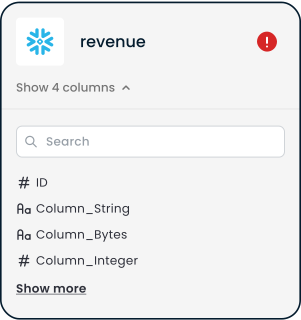
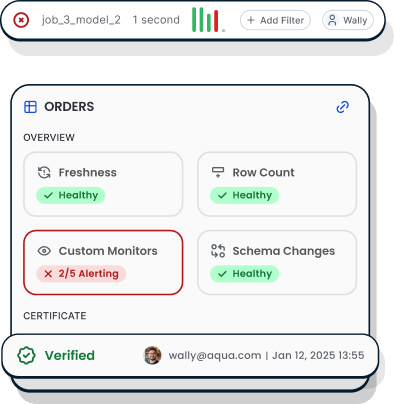
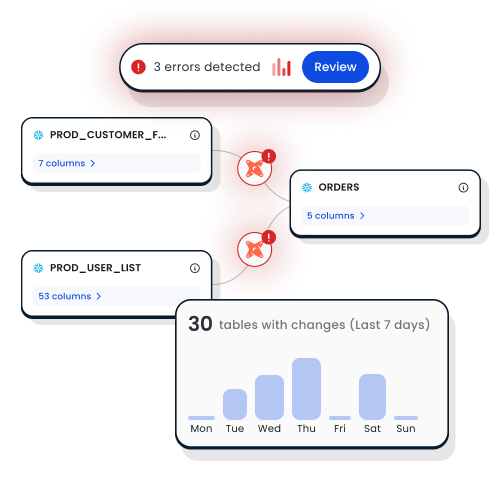


Data lineage is a map of how data moves through your systems, from source databases through transformations to final destinations. It shows the complete journey and answers questions like "where does this metric come from?" and "what breaks if I change this table?
Matia captures lineage natively in ingestion and reverse ETL pipelines at execution time. For dbt and BI, we parse transformation logic like other tools. What sets us apart is integration: lineage connects with Observability insights in one platform, eliminating the need to jump between tools to understand data flow, quality, and operational health
Yes. Matia integrates with dbt Core and dbt Cloud, automatically parsing your dbt project to build lineage graphs. You don't need to change your dbt workflow.
You're probably going to hate this answer, but it depends on a few factors. Namely, data volume, number of connectors, numbers of streams. It can take some customers 1 hour and others 2 weeks. After scoping out your individual needs, we can give you a better idea.
We are fully backwards compatible with Fivetran as well. We wrote a little bit more about why data teams may not want to migrate to a platform like Matia.
Yes. Matia's lineage graph spans across Snowflake, BigQuery, Redshift, Databricks, and other warehouses, showing you cross-platform dependencies.You're probably going to hate this answer, but it depends on a few factors. Namely, data volume, number of connectors, numbers of streams. It can take some customers 1 hour and others 2 weeks. After scoping out your individual needs, we can give you a better idea.
Data teams use lineage across the entire data lifecycle. During incident response, trace backwards from broken dashboards to root causes in minutes. Before schema changes or migrations, identify every downstream dependency to avoid breaking production systems. For AI/ML, understand how source data flows through feature engineering to model outputs. Compliance teams use lineage to document data handling for SOC2, GDPR, and HIPAA audits. And analysts trace metrics back to source tables to understand calculations without asking engineers. We’ve even seen companies leverage lineage for FinOps use cases.


.avif)




.svg)



