

ETL, Observability, Catalog, Reverse ETL - Finally in One Platform
Stop spending all your time and budget just maintaining your data stack, so your team can focus on using your data to build what’s next.

Trusted by

.svg)

.svg)

.svg)


.svg)
.svg)

.svg)
Is your Team Trapped in Data Triage?
.svg)
Running on 4+ platforms
.svg)
Hit with yearly price hikes.
Zero big-picture visibility.
Debugging is a pain in the ass.
AI innovation dead in the water.
.svg)
Running on Matia
.svg)
One invoice and lower TCO.
End-to-end visibility.
One fast support team.
Clean, AI-ready data.
Choose Matia
Less headaches. More functionality. Get your data working for you. It can and should be that simple.
Book a Demo


Because when your data tools share context, everything changes
Transformation

Alert Destinations
Source
.svg)
Warehouse
Destinations
Reverse ETL
Send warehouse data back to operational tools to power real-time business decisions.
Warehouse
.svg)
Destinations
Learn more
Observability
Monitor data flows and catch errors at the source before they reach your warehouse.

Source
Warehouse
Destinations
Learn more
Catalog
Organize and trust your data assets with lineage tracking and clear ownership.
Source
Warehouse
.svg)
BI/Analytics
Learn more
Catch problems before they become pipeline failures
Matia monitors at the source, so problems (like schema changes and anomalies) get flagged before they reach your warehouse. And when something does need fixing, full lineage provides end-to-end context.
.svg)
End-to-end lineage
.svg)
Real time monitoring
Reduce data stack spend by up to 61%
Replace Fivetran, Reverse ETL, Observability and Catalog tools with one predictable bill. And save on your Snowflake or Databricks compute costs with Matia’s parallel syncs.
Learn more
Confidently enable AI with full context
With everything running through a single pipeline, Matia gives your AI the clean, connected, fully-contextualized data it needs to effectively function. Backed by metadata, a semantic layer, and data quality.
.svg)
Metadata context layer
.svg)
Data observability
Learn more
Meet the teams doing more with Matia and saving more while they do it

.svg)

.svg)

.svg)
"Matia has been huge for us. We've seen significant improvements in reliability, fault tolerance, and product velocity compared to the alternative and reduced our sync ime by more than 80%."

.svg)
"When it comes to reliable data, Matia delivers. From a technical perspective, the product is superior and the velocity with which they are able to ship new features is impressive"

.svg)
"Moving to Matia, our goal was to unify siloed systems to move data faster and more reliably. The Matia platform has lived up to the hype and more. Having a single source of truth for data means our engineers can focus on our product innovation, instead of fixing broken and inconsistent data pipelines."


"Matia didn't just help us move data; it made our AI workflows operational. We can now get model outputs from Databricks into our platform fast enough to make a difference for our customers."

.svg)
"When we ran into an issue with our data, Matia came back with a solution. That's the kind of partnership that actually moves the needle for a data team."


"It's a dream to have Matia as a one stop solution now where I can just go in, I can just do all the data movement in one place with no issues."



Built for the way data teams actually work
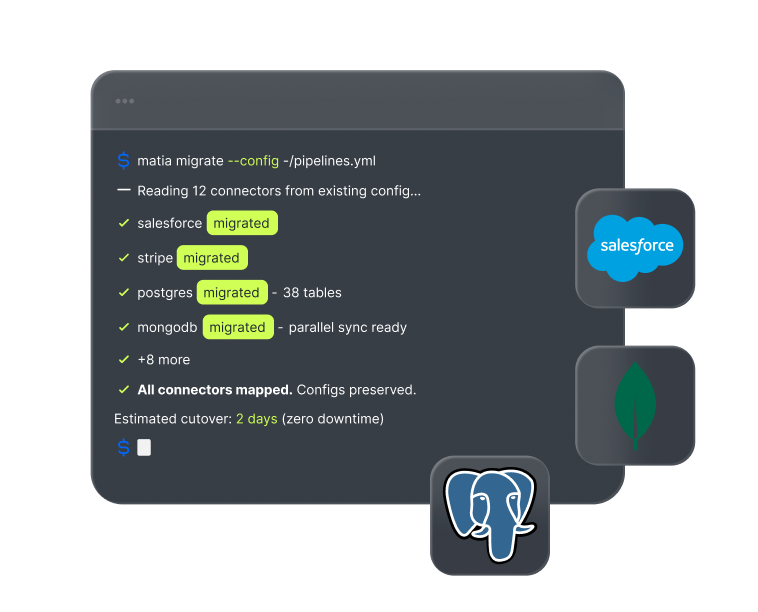
Migrate your data stack in days, not months
Matia is backwards compatible with Fivetran. Your existing pipelines, connectors, and configs migrate without rebuilding from scratch.
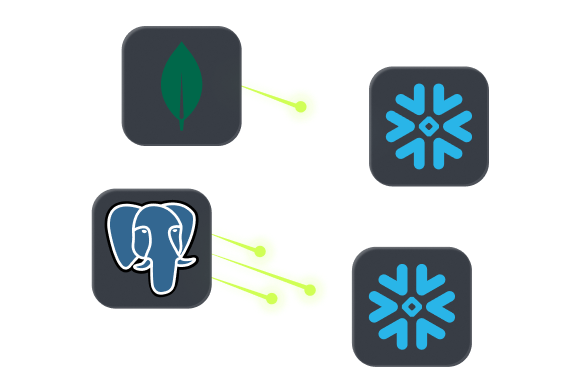
Parallel syncs
Sync large volumes of data up to 28x faster, even with MongoDB and Postgres,.
150+ integrations, built the right way
Connect any source to any destination — from Snowflake and Redshift to HubSpot and Salesforce. Need something custom? We build new connectors in as little as 48 hours. No waiting, no workarounds.
View Integrations
5-minute support responses
Stop waiting days for a response. Our support team is the reason our customers love us.
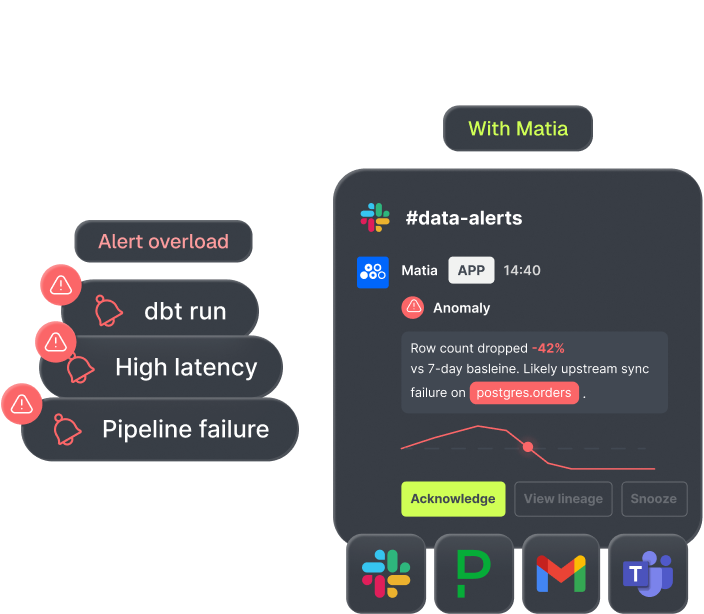
Reduce the noise with native app alerts
Get pipeline alerts, anomaly notifications, and monitor summaries delivered where your team already lives.
Discover everything Matia can do
Keep Your Data Game Strong
Stay ahead with the latest insights and best practices from Matia’s experts
.svg)


© All rights reserved Matia 2026


