
.svg)


When AI Quality Drops, Look at the Data Pipeline First


Model quality gets most of the attention in AI, but models are often not the first thing to fail in production. More often, the problem begins upstream in the data pipeline.
When an AI model starts producing weaker recommendations, less useful summaries, stale answers, or inconsistent decisions, the model may simply be reflecting a problem in its inputs. Data may have arrived late, changed shape, lost important context, been duplicated, or drifted gradually without causing a hard failure.
That is the operational reality of production AI: the model generates the output, but the data determines whether that output can be trusted.
If an AI model depends on your data warehouse, reliability starts with observability at the data layer. Teams need to identify problems before users notice that something feels wrong, not after output quality has already declined.
There are many different ways data can fail, but these five failure modes are among the most common ways AI data pipelines break in production. They are also the kinds of problems teams can catch early with the right monitoring and lineage.
An outdated view of reality
Stale data is common because it can be difficult to detect from the application layer. A source system stops updating on schedule, replication begins to lag, or a sync job continues to succeed while reading old data. Downstream transformations still run, and the AI application still returns an answer, so the system appears healthy.
In practice, however, the AI is reasoning over an outdated version of the world. An internal copilot may summarize yesterday’s support queue instead of today’s. A recommendation engine may miss a user’s most recent activity. An account intelligence workflow may rely on old customer attributes. An agent may retrieve data that is technically available but no longer current enough to trust.
The mistake is monitoring whether jobs ran instead of whether the data is fresh. A pipeline can be green while its outputs are already wrong.
Exactly how you monitor for data freshness depends on the data itself: Where is it coming from? How often is the data expected to update? What is the SLA for this data? At a minimum, you can monitor the lag between event time and warehouse availability to help determine whether each asset is updating at its expected cadence.
Matia makes those signals visible at the data layer, where the problem begins. By default, Matia will monitor for data freshness on all of your data pipelines, no configuration necessary! Rather than waiting for someone to report that “the AI feels off,” teams can identify which upstream asset stopped arriving on time, when it departed from its normal pattern, and, using Matia’s lineage capabilities, which downstream pipelines, models, or AI-facing tables are affected. That replaces subjective debugging with evidence.
Important context is lost
Schema drift can cause serious damage without creating an obvious outage. A column may be renamed, a nested object may change shape, a previously dependable field may start arriving as null, or a data type may change just enough to disrupt one transformation branch without breaking the entire pipeline.
The job still runs, the table still materializes, and the model still responds. What has changed is the quality of the context available to the AI.
That degradation can appear in several ways. Prompts may lose customer or product attributes. Retrieval pipelines may drop metadata that is necessary for relevance. Scoring jobs may receive incomplete inputs. Generated outputs may become more generic, vague, or inconsistent.
AI systems are especially sensitive to partial data failures because their usefulness often depends on rich, structured context. A traditional analytics workflow may remain usable when one field disappears. An AI workflow can lose quality immediately, even when the broader pipeline appears intact.
Teams should monitor schema differences across runs, contract changes in critical sources, sudden increases in null values for important fields, and growing sparsity in downstream data after an upstream change.
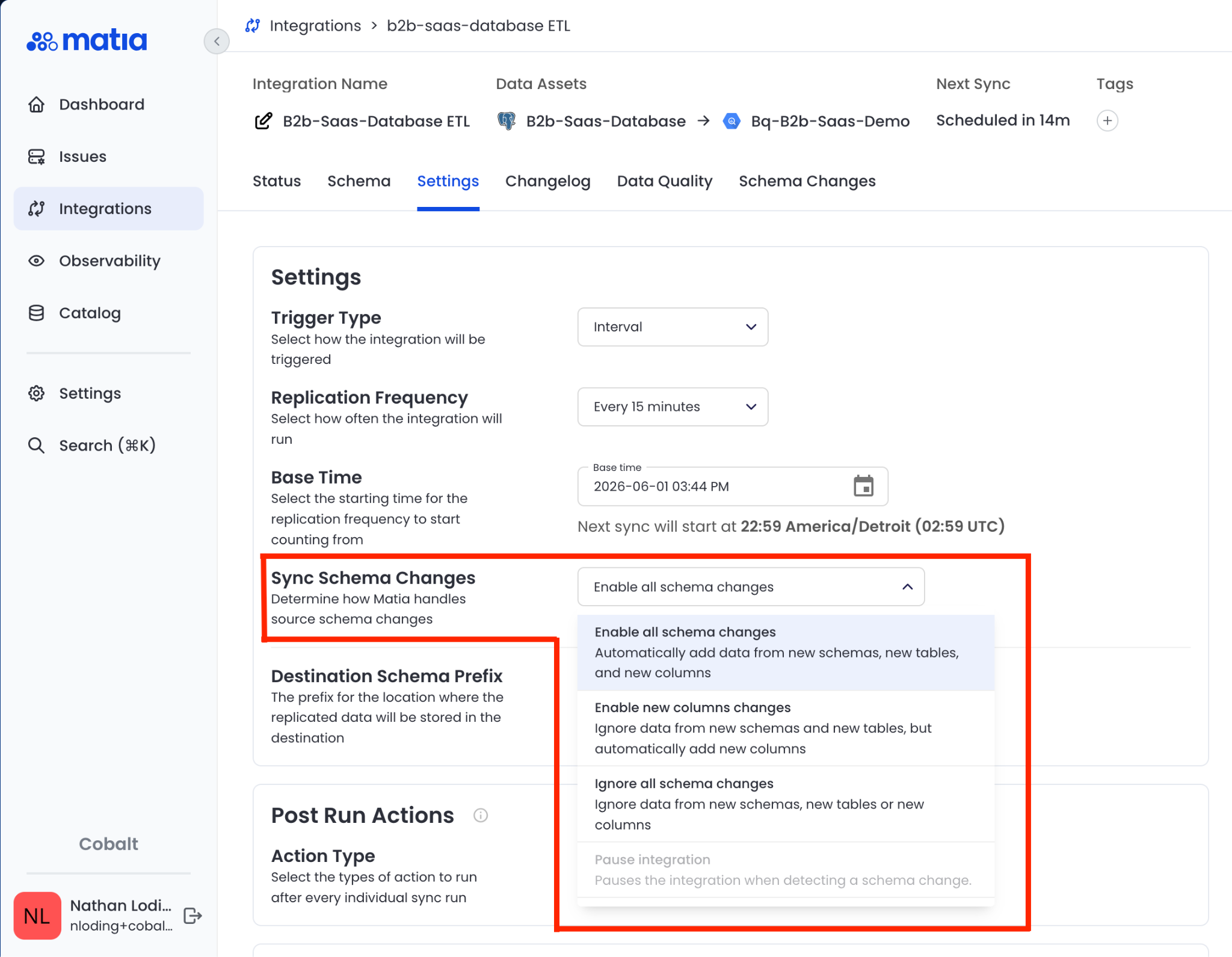
Matia helps teams detect schema issues at their source and trace the downstream effect through lineage. Instead of discovering the problem only after output quality declines, teams can see which source contract changed, which transformation was affected, and which AI workflows are now consuming incomplete data. That shortens the path from a vague symptom to a specific root cause. When a schema change occurs, you can choose to automatically add those changes to the pipeline or ignore them, or pause the pipeline until the team has a chance to review. Every schema change is logged and visible, allowing full historic review of every change.
The pipeline loses business context
Most production AI systems do not operate on raw data alone. They depend on enriched data assembled from multiple sources. Usage events may be joined to account records. Support tickets may be connected to customer metadata. Product telemetry may be enriched with pricing tiers, account owners, or regions. Documents may be linked to business context before they are embedded, indexed, or added to prompts.
When those joins fail, the system often continues to run, but the business meaning disappears. A match rate may fall from 98 percent to 63 percent. A key format may change. An upstream source may become incomplete. A transformation may still finish successfully even though half of the enrichment fields are now null.
At the application layer, the result may look like generic recommendations instead of personalized ones, weak account-aware responses, less relevant retrieval, or summaries that omit important business context. The AI still works in a technical sense, but it is noticeably less helpful. The infrastructure has not failed; the system has lost meaning.
The most important signals are join match rates, null rates in enriched fields, row-count changes before and after joins, the completeness and validity of join keys, and shifts in distinct counts for important business attributes.
Matia makes this kind of transformation-layer degradation visible before it becomes a product problem. Row count monitors come default with your data pipelines, and you can write custom SQL monitors to identify data-specific anomalies. Once the broken table is identified, users can trace the resulting loss of context through lineage, and determine which downstream assets, dashboards, feature tables, or AI workflows are operating with degraded business meaning.
The pipeline amplifies noise and treats it as signal
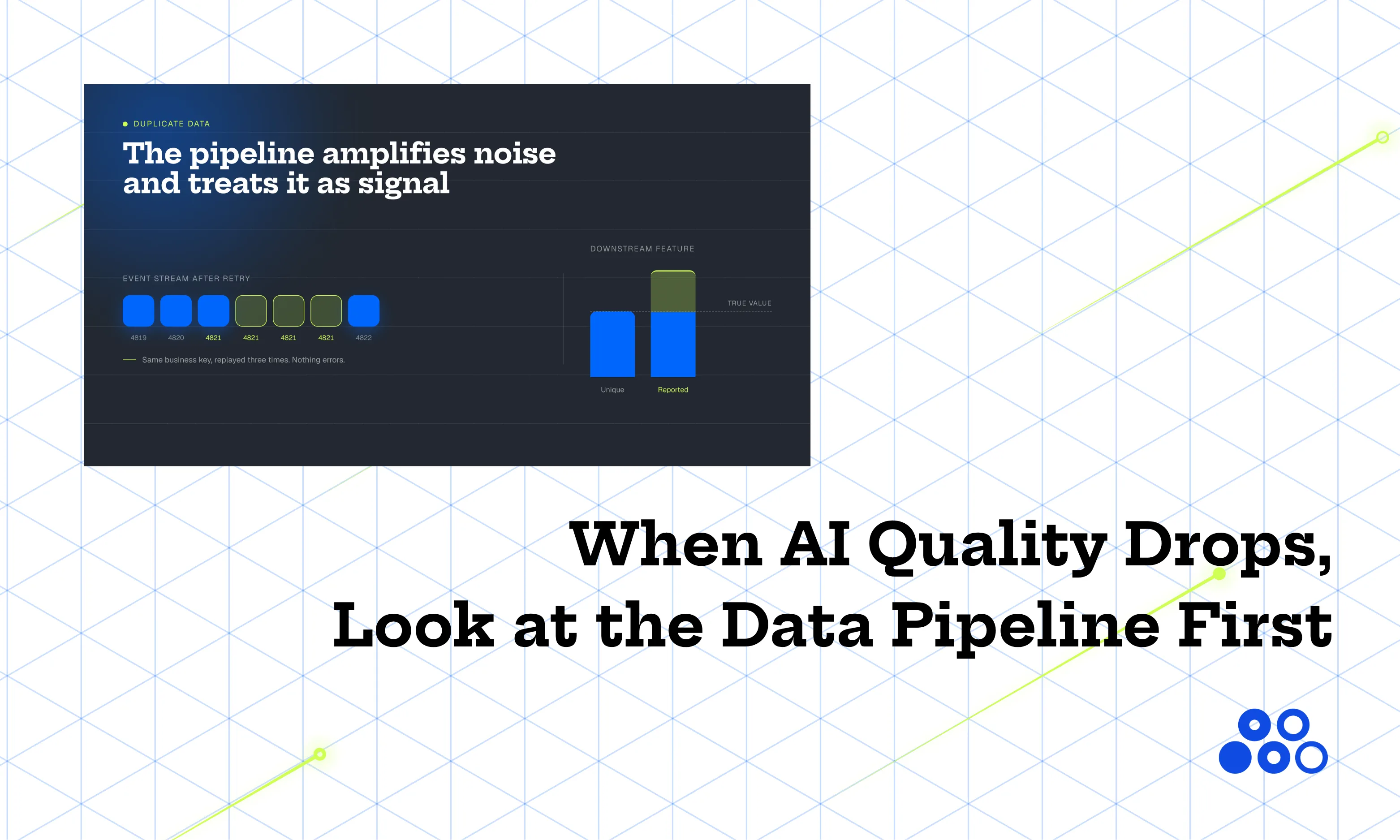
Duplicate data is particularly dangerous in AI systems because the result often looks plausible. A batch may replay, a retry process may not be idempotent, a source may emit the same events more than once, or a document indexing job may ingest identical content twice.
As with so many of these failures, it can be nearly invisible. Nothing crashes, but the downstream system now has a distorted view of reality. Duplicates can inflate user activity signals in feature tables, cause ranking systems to overweight repeated events, introduce redundant content into retrieval pipelines, skew training or inference inputs, and create false confidence in patterns that are really artifacts of replayed data.
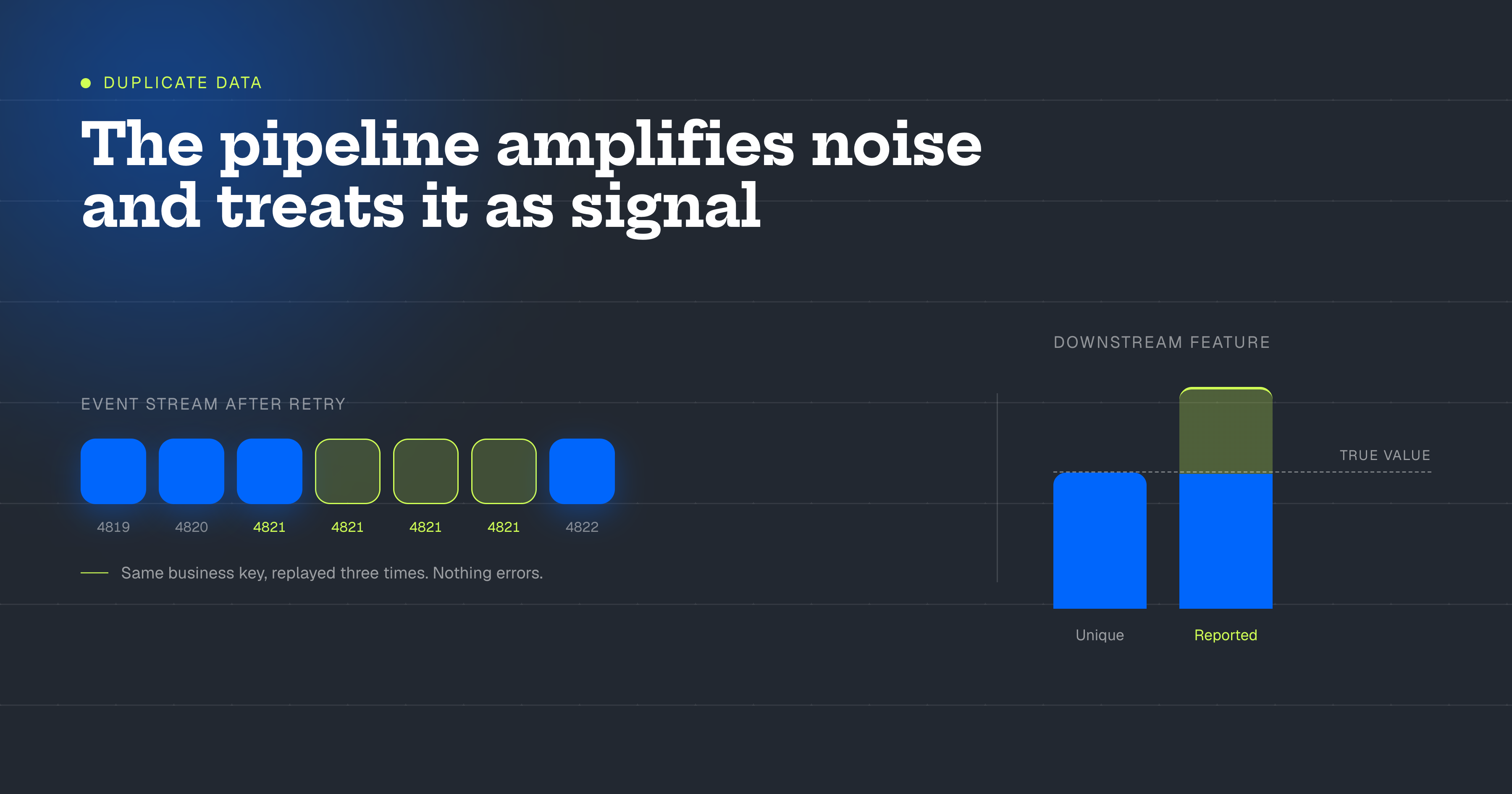
AI systems can be more vulnerable to this problem than traditional analytics. A dashboard with duplicated records may look suspicious enough to prompt investigation. A model or ranking system may simply absorb the distortion and return a confident-looking result.
Teams should monitor uniqueness by business key, unexpected row-count growth, duplicate rates in critical tables, and replay spikes following retries or recovery workflows.
Matia helps detect duplication before it contaminates downstream logic. Using custom SQL monitors for data quality checks and anomaly detection can surface unusual growth, key duplication, and replay patterns early enough for teams to stop bad data from propagating further downstream.
The hardest failures are the ones that still look normal
Some of the most frustrating AI incidents happen when every component is technically functioning. A feature table may arrive late without being completely missing. A text field may begin to truncate. A column may continue to populate even though its value distribution has shifted. Null rates may rise slowly, category mixes may change, or the timing and shape of the data may drift just enough to reduce output quality without creating a visible outage.
But the pipeline still completes and looks stable, and the model still responds, but users gradually begin to trust the result less. These incidents consume time because teams often investigate the wrong layer first. They tune prompts, compare models, rerun evaluations, and debug inference paths when the underlying problem is that the input data no longer matches operational expectations.
Quiet degradation can make rankings noisier, weaken personalization, increase false positives, and produce less grounded outputs. Often, the only initial report is that the system “seems worse lately.” Although the symptoms may eventually appear in model monitoring, the underlying issue begins as a data observability problem.
Useful signals include feature freshness, the readiness of dependencies before scoring or inference, distribution shifts, cardinality changes, null-rate changes, and changes in text length or token-length patterns for LLM inputs.
Once again, Matia’s observability platform gives teams visibility into the health of the data feeding AI systems. Teams can catch delays, drift, and unexpected changes in data shape with Matia’s observability suite, then use lineage to identify exactly which downstream AI workflows are exposed.
AI reliability depends on pipeline reliability
Across all five failure modes, the pattern is consistent: The model is where the problem becomes visible, but the pipeline is often where it begins.
That is why “the job succeeded” is not a meaningful reliability standard for an AI system. Trustworthy production AI requires confidence that the data is fresh, the schema is stable, joins are holding, duplicates are controlled, inputs are arriving on time, and downstream impact can be traced when something changes.
Those capabilities are part of the operational foundation that turns an AI demo into a production system people can rely on.
This is why unified DataOps matters
Matia is designed for this class of failure. The important question is not simply whether a table exists, a job ran, or a dashboard is green. It is whether the data feeding a critical system is reliable enough to support trustworthy decisions and outputs.
For AI systems, that means surfacing stale upstream data before copilots or models operate on old context, identifying schema changes before prompts and feature pipelines lose important fields, catching broken joins before enrichment disappears, detecting duplicate loads before signals become distorted, and flagging drift or delay before output quality begins to erode.
Because Matia connects data quality, freshness, transformations, and lineage, teams can move more quickly from “something seems wrong” to a specific explanation: an upstream asset changed, these downstream systems are affected, and this is what needs to be fixed. That clearer path from symptom to cause is the basis of operational trust.
Conclusion
Most production AI failures are not dramatic. They do not always fail a job or break an application outright. More often, they appear as a gradual decline in output quality and trust.
The companies that succeed with AI will not be defined only by the models they choose. They will be defined by the operational discipline they apply to the data pipelines feeding those models.
If AI outputs matter to the business, the pipelines behind them need observability. The best place to catch many AI failures is not the model itself, but the data that reaches it.

.png)





.svg)


