
.svg)


Welcome to the Matia Documentation Hub


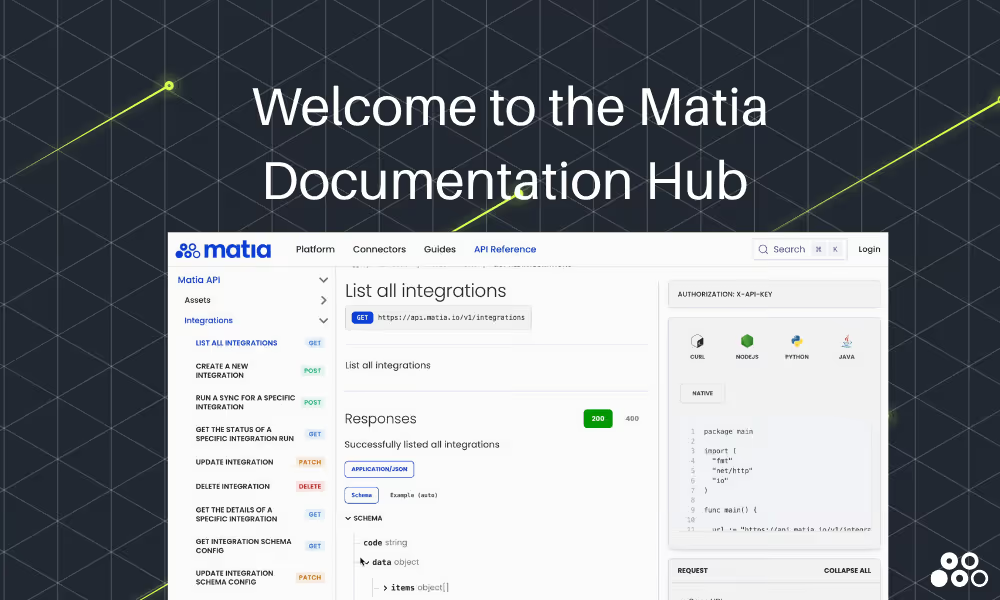
Good documentation doesn't just answer questions. It removes the gap between "I want to build this" and "I built it." For data engineers and developers working with Matia, that gap just got even smaller. As AI agents become a bigger part of how data teams operate, that gap extends beyond your engineers. Agents need to understand your platform just as well as the people building on top of it.
Today, we're launching the Matia Documentation Hub, a centralized, structured knowledge base covering every part of the platform. Connector schemas. API references. Setup guides. Step-by-step workflows for syncs, monitors, Reverse ETL, and more. Matia is a unified data operations platform. Your documentation should reflect that.
What’s Included?
150+ Connector Schemas, Fully Documented
Every connector in Matia now has a dedicated reference page covering stream-level schema information, field types, primary keys, replication methods, and freshness behavior. If you're evaluating whether a source connector will give you the data you need before you configure it, that information is now available without a support ticket.
This covers all 150+ connectors across Matia's supported sources and destinations. A few of the most commonly used:
- Postgres: table-level stream configs, replication slot behavior, column types, and primary key handling.
- HubSpot: CRM object streams including contacts, companies, deals, engagements, and custom properties.
- Salesforce: object schemas across standard and custom objects, field-level metadata, and incremental replication details.
- Salesloft: cadence, person, and activity stream schemas with field type references.
- Stripe, Snowflake, BigQuery and 150+ more: each with the same depth of stream and schema coverage.
.gif)
If you're evaluating whether a connector will surface the data your models depend on, the answer is in the docs before you even attempt to configure it.
You can navigate to each of the documentation pages directly from the documentation hub, or from the site.
Getting Started: Core Concepts
New to Matia, or onboarding a new engineer onto the platform? The Getting Started section walks through the fundamentals without assuming context.
Three core tracks to get you operational:
- First Integration: Connect a source, configure a destination, and understand how Matia handles schema detection, sync scheduling, and replication modes.
- First Monitors: Set up observability on a pipeline. Understand freshness checks, row count monitoring, and how alerting routes through to your team.
- First Reverse ETL Sync: Sync modeled data from your warehouse to a downstream tool. Configure field mappings, set sync behavior, and validate that records are landing correctly. You can trigger Reverse ETL based on the success of a dbt job.
Each track is structured as a step-by-step flow, allowing you to be able to get something operational with the documentation.
API References
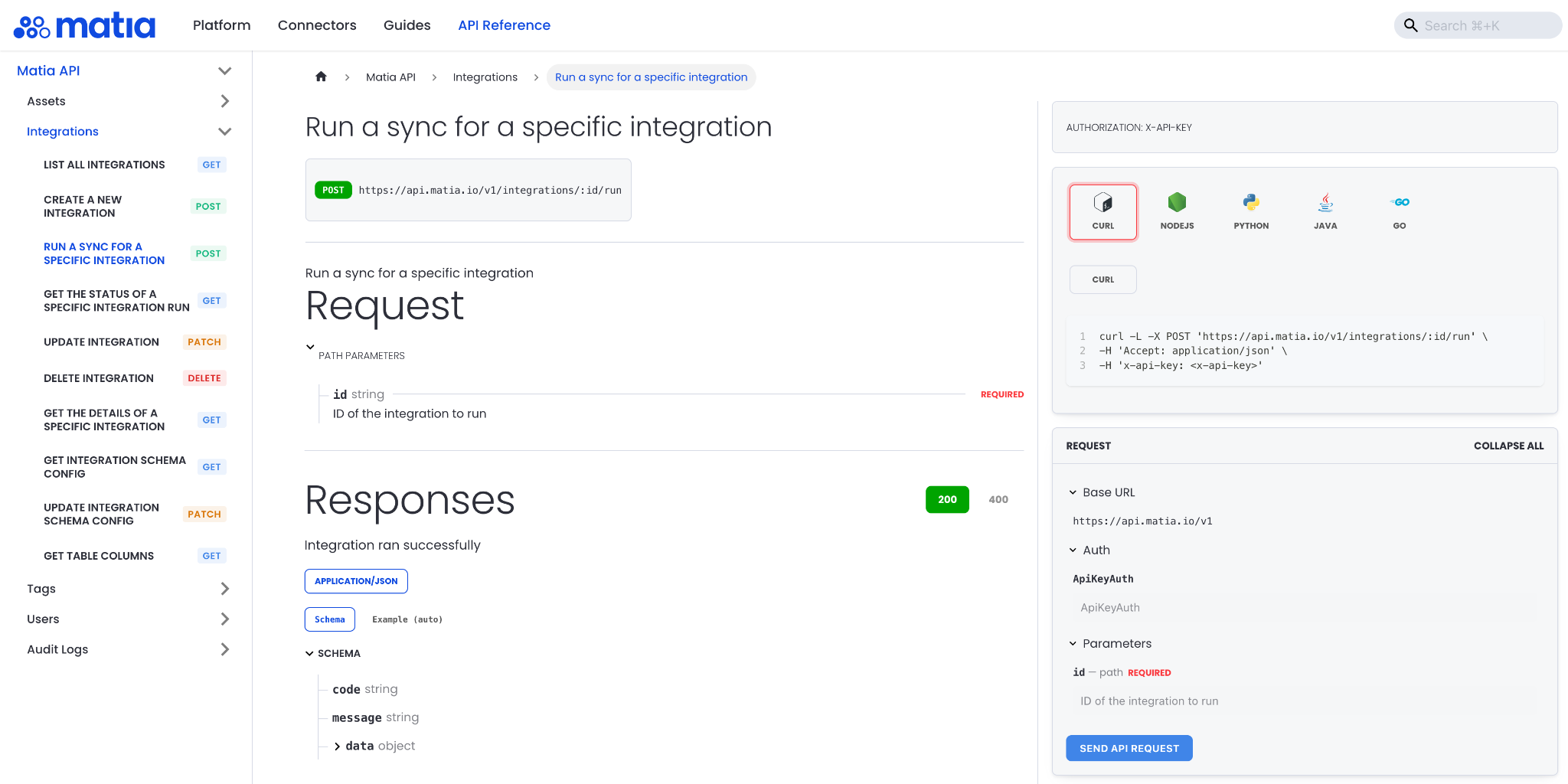
Matia's API is the backbone for teams that build internal tooling or integrate Matia into broader data platform workflows.
The API section covers authentication, endpoint structure, request and response formats, rate limits, error codes, and pagination behavior. If you're building against the API, this is the reference you'll keep open.
Platform Guides: Operational How-Tos
Beyond getting started, most teams have recurring operational questions. How do you handle a schema change without breaking a downstream model? How do you configure a sync to run on a custom schedule? How do you set up notifications so the right person gets paged when a pipeline goes stale?
The Guides section answers these with focused, task-oriented walkthroughs. Current guides include:
Handling schema changes and field additions
- Setting up notifications and alerting on integrations
- Managing multiple environments (dev, staging, production)
- Configuring Reverse ETL sync modes and conflict resolution
- Viewing table lineage
This list will grow continuously. When a question comes up repeatedly in support or in conversation with customers, the answer should exist in the docs.
Built for How Engineers Actually Work
Documentation that requires you to read everything to find anything is not documentation. The Matia Documentation Hub is structured around how engineers actually navigate: by connector, by how-to, but API info and more.
Search is fast, and the Getting Started tracks are separated from the reference material. Connector schemas are in one place, and API documentation is organized by endpoint, not by internal product concept.
If you're mid-implementation and need to know what a specific field returns, you can get there in under thirty seconds.
What's Coming: AI-Assisted Documentation
We're building something for the cases where even the best-structured docs leave a gap. You have a specific question about your schema, your configuration, or how two Matia features interact in your particular setup. You don't want to search, you want an answer.
We'll have more to share on this soon. The goal is to make expert-level answers available to every engineer working in Matia, not just the ones who've been using the platform for two years.
Start Using the Documentation Hub
The Matia Documentation Hub is available now at docs.matia.io.
If you're already a Matia customer, the documentation hub reflects the current state of the platform including your available connectors and API version. Bookmark it.
If you're evaluating Matia, the connector schema pages and API reference give you a clear picture of what the platform supports before you start a trial.
And if something's missing, tell us. Reach out at hello@matia.io or if you’re a customer, your individual slack channel. The goal is a documentation hub that earns a permanent tab in your browser, and that only happens if it answers the questions you actually have.
We’ll keep building in the meantime.






.svg)


