
.svg)


Silent Failures, Loud Consequences: What Drata Learned About Building AI-Ready Data Systems


Most teams assume AI failures happen because the models are bad.
In reality, the problem usually starts much earlier, with the data itself.
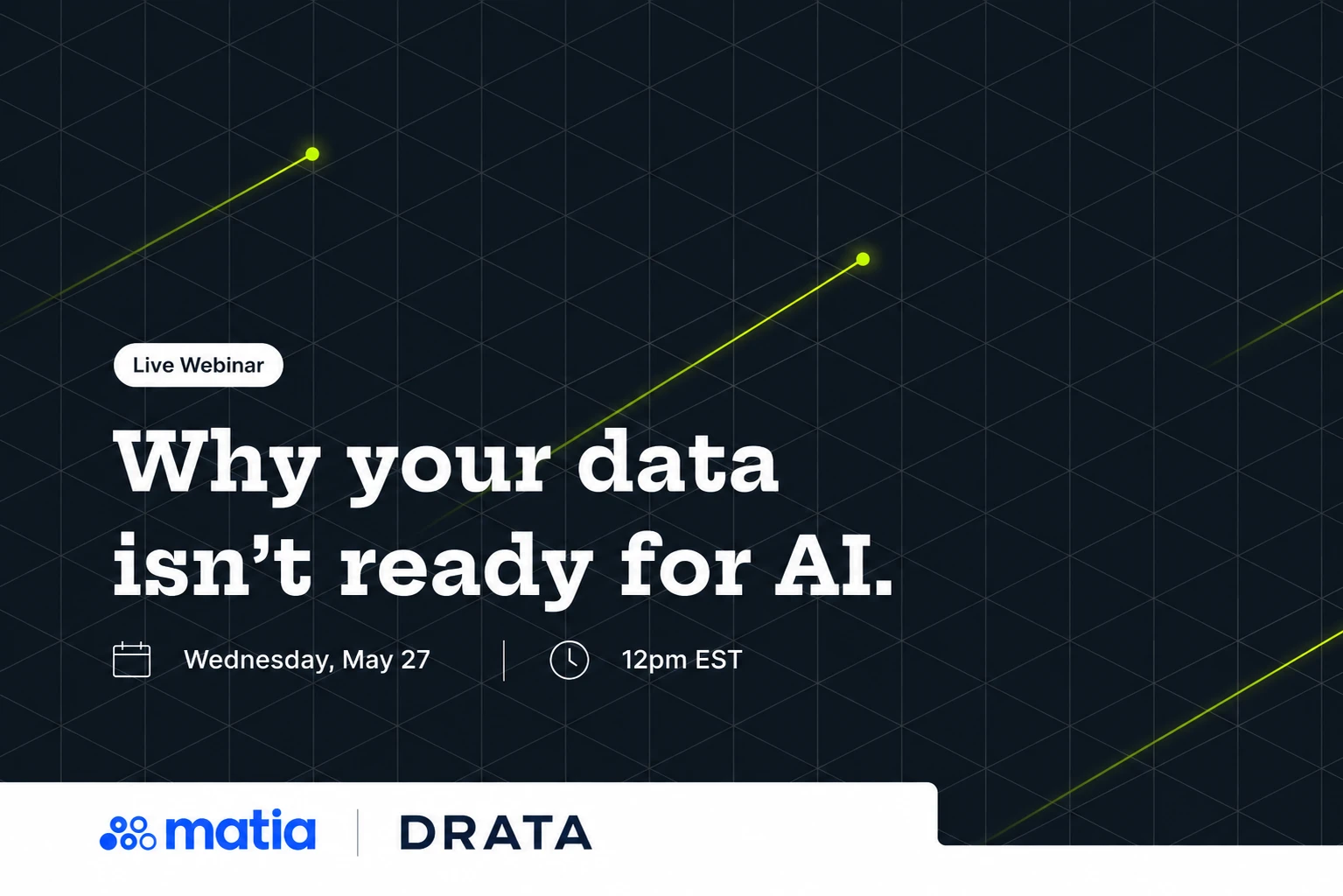
That was one of the biggest themes from Matia’s recent webinar with Nathan Loding, Data Advocate at Matia, and Matthew Shump, Head of Data & Analytics at Drata. The conversation focused on a growing challenge facing modern data teams: pipelines may look healthy on the surface, while quietly delivering stale, incomplete, or corrupted data into downstream AI systems.
And when that happens, the outputs can look correct while being fundamentally wrong.
The Problem with “Green” Pipelines
One of the most important points discussed during the webinar was the difference between a pipeline that is operational and a pipeline that is trustworthy.
Many organizations monitor whether jobs are completed successfully. But success states alone don’t guarantee data quality, freshness, or reliability. A pipeline can technically “run” while still introducing silent issues downstream:
- Schema changes that quietly break transformations
- Delayed or stale data feeding dashboards and AI models
- Duplicate or incomplete records
- Context loss across systems
- Failures that don’t surface until business decisions are already affected
This becomes especially dangerous in AI workflows, where systems consume and act on data automatically at scale.
As AI adoption accelerates, the cost of these hidden failures grows significantly. Teams aren’t just powering dashboards anymore: they’re feeding data directly into operational systems, decision engines, copilots, and AI driven workflows.
Why Observability Alone Isn’t Enough
Another major theme from the discussion was the idea that modern data stacks have become increasingly fragmented.
Over the last decade, teams adopted separate tools for ETL, orchestration, observability, governance, activation, and transformation. While each category solves a specific problem, the result is often a disconnected ecosystem where teams lack complete visibility into how data moves, changes, and impacts downstream systems.
The webinar explored how observability needs to evolve beyond simple alerting.
It’s no longer enough to know that a pipeline failed. Teams need context around:
- What changed
- Which downstream systems are affected
- Whether data freshness has degraded
- How schema drift impacts AI outputs
- Where trust in the data begins to break down
This is especially critical as organizations begin operationalizing AI across the business.
Drata’s Perspective on Reliable Data Operations
Matthew Shump shared insights into how Drata approaches reliability and operational trust within modern data systems.
One of the key takeaways was that reliability isn’t something added later, it has to be designed into the workflow itself. As data systems scale, small inconsistencies compound quickly, particularly when multiple downstream teams and AI systems rely on the same datasets.
The discussion emphasized the importance of:
- Monitoring freshness and schema changes proactively
- Building systems that surface issues before they become business problems
- Creating visibility across the entire data lifecycle
- Reducing operational complexity while maintaining trust
Rather than treating data quality as a reactive exercise, leading teams are moving toward more continuous, context aware approaches to reliability.
AI Raises the Stakes for Data Teams
Perhaps the clearest message from the webinar was this:
AI increases the importance of reliable data infrastructure.
When humans consume bad data, they may eventually spot inconsistencies. AI systems often do not. They continue producing outputs confidently, even when the underlying data is flawed.
That creates a new operational challenge for modern data teams.
The future of AI readiness is not simply about deploying more models. It’s about ensuring the systems feeding those models are observable, trustworthy, and resilient enough to support production scale decision making.
As organizations continue investing heavily in AI initiatives, the teams that succeed will likely be the ones that solve the foundational reliability problem first.
Watch the Full Recording
Watch the on demand webinar featuring Nathan Loding from Matia and Matthew Shump from Drata to learn more about silent data failures, AI readiness, and the future of reliable data systems.

.png)





.svg)


