
.svg)


Parallel Syncs: Cutting Waste at the Warehouse


Parallel Syncs: Cutting Waste at the Warehouse
Every data team has a table they secretly hate.
It might be a giant NetSuite accounting table, a high-volume production database stream, a Salesforce object with years of history, or some operational table that started small and quietly turned into a monster. Most days, it syncs well enough. Then someone needs a full refresh, a historical backfill, or a pipeline recovery, and suddenly the “normal” ingestion job becomes a multi-day event.
That’s when ingestion speed stops being a convenience metric and starts becoming a business problem.
Slow syncs mean stale dashboards. Not only are finance, operations, and leadership looking at old numbers, but downstream dbt jobs wait around, BI models get delayed, and data engineers spend time babysitting pipelines instead of improving the platform. And in modern cloud data stacks, slow syncs can also mean real infrastructure cost.
Snowflake virtual warehouses consume credits while they execute queries, load data, and perform DML operations. Warehouse usage is billed based on size and runtime, with per-second billing after a 60-second minimum. Databricks also uses pay-as-you-go pricing at per-second granularity. BigQuery is different, but the cost relationship is still there: on-demand pricing is tied to bytes processed, while capacity pricing is tied to slot-hours, with query processing capacity measured over time.
The short version: when ingestion keeps compute busy longer than it needs to, you usually pay for that drag somewhere.
The problem with single-lane ingestion
A lot of ingestion systems still use a single stream, pulling data through a one lane highway.
They connect to the source, read a batch, write it to the destination, checkpoint progress, and repeat. That sequential model is fine for small tables. It breaks down when the source has hundreds of millions or billions of records.
Matia’s approach is different. Parallelism is one of Matia’s core technical differentiators in data ingestion. Instead of treating a large data pull as one long sequential job, Matia can run multiple sync clients at the same time, breaking the work into smaller chunks that run concurrently.
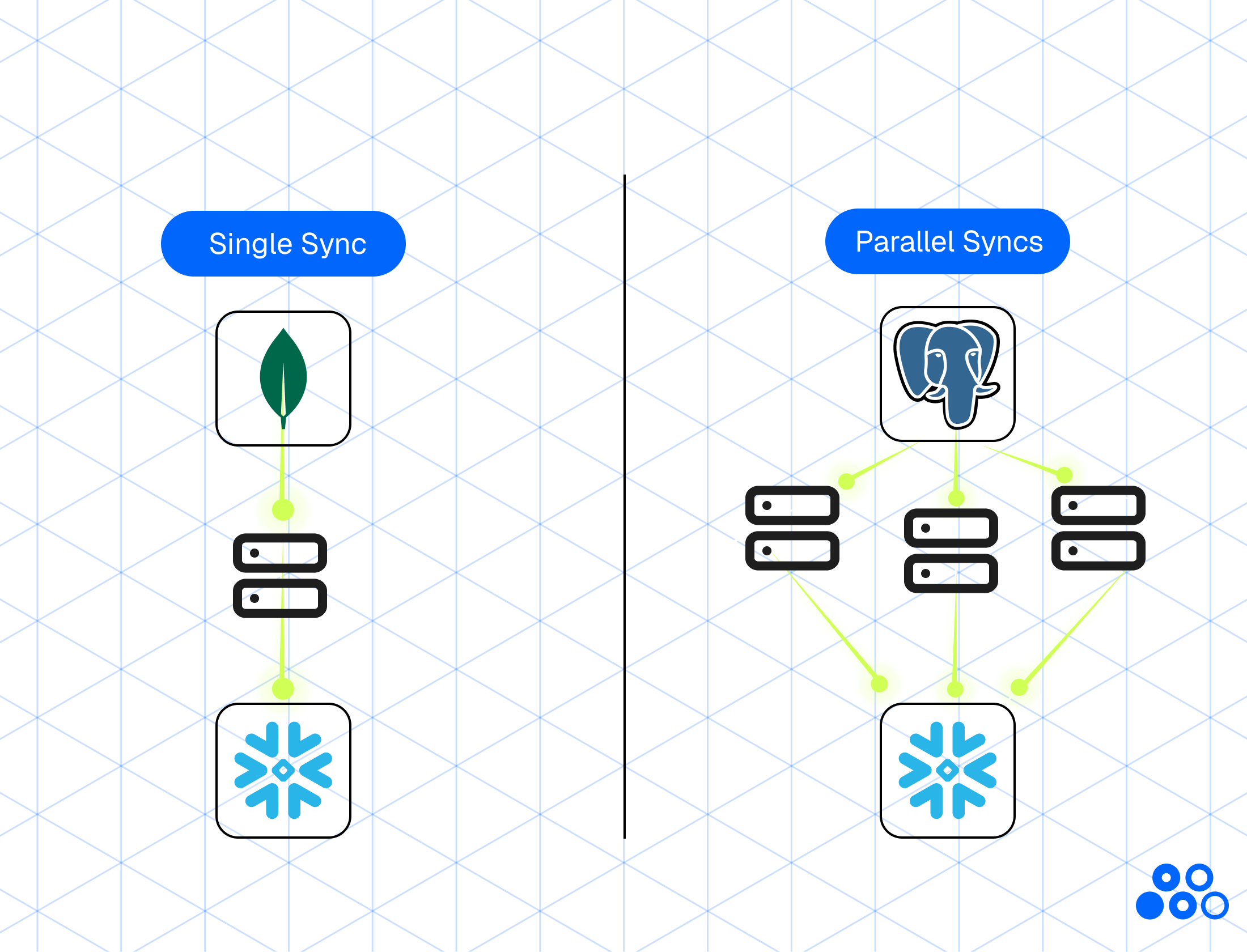
For data engineers, the idea is pretty straightforward: partition the pull, coordinate the work, and load the destination without turning correctness into a casualty.
From two weeks to one day
With Matia, you can reduce sync time by an average of 8x.
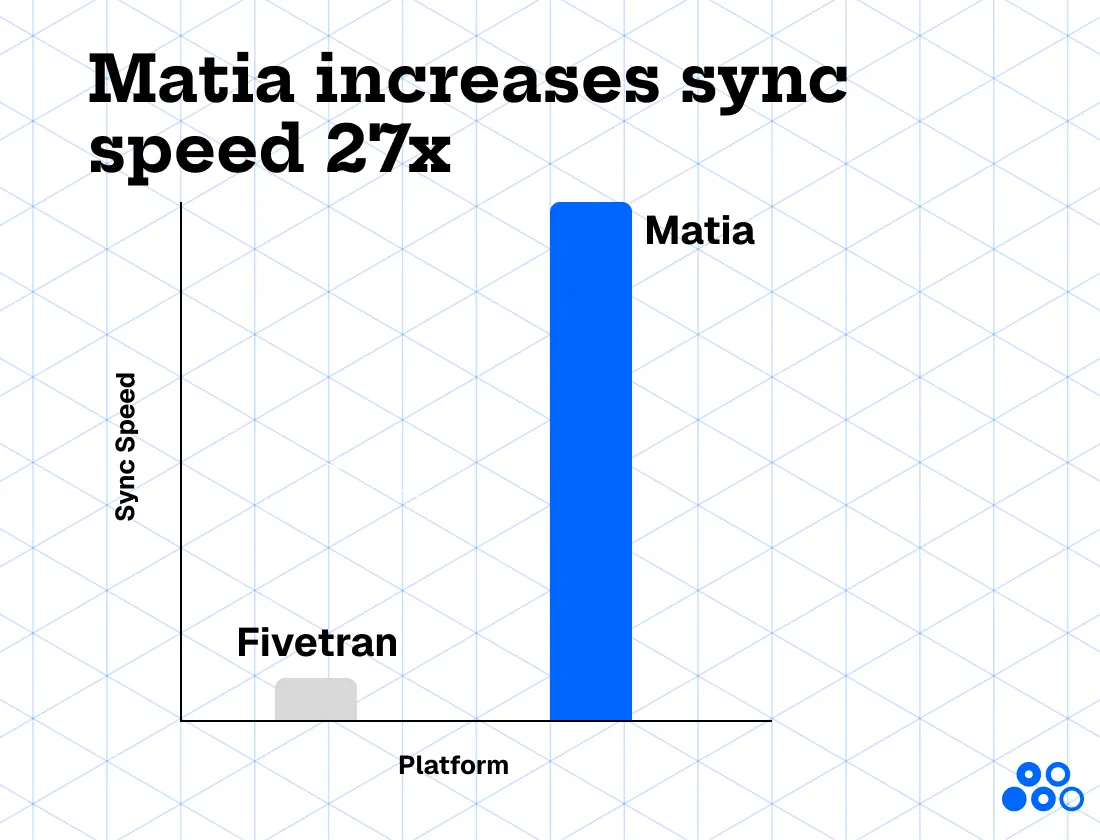
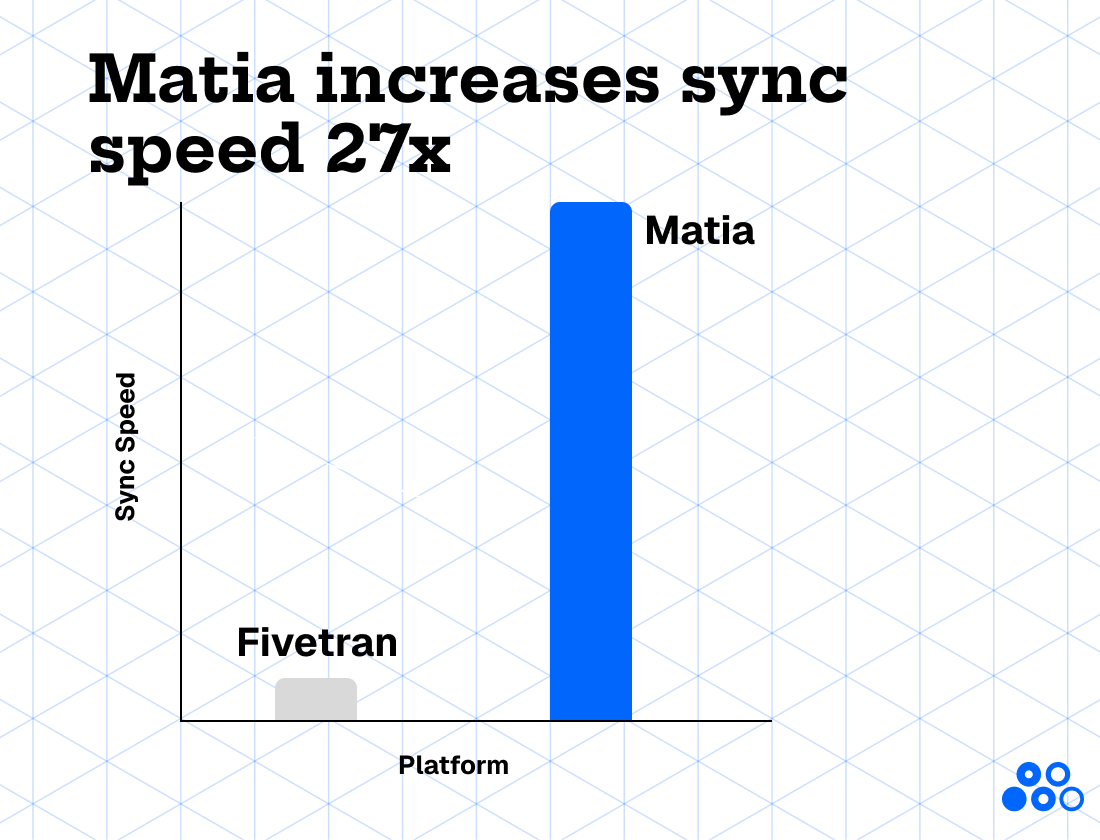
One Matia customer had a massive TransactionAccountingLine stream with close to 1 billion records. When using Fivetran, a full refresh took roughly two weeks. Reporting was stale long enough that executives were frustrated, and understandably so. This was not “the dashboard is five minutes behind.” This was “the business is flying blind on important reporting.”
After switching to Matia, the full refresh completed 27x faster. A refresh that took 14 days was brought down to less than a day.
The cost implication is just as important. For the runtime-metered parts of the stack, a 27x runtime improvement can reduce the runtime-dependent portion of a workload by about 96%, assuming the same compute footprint.
That does not mean the total warehouse bill drops 96%. Real bills include transformations, BI queries, storage, background jobs, streaming, orchestration, and plenty of other workloads. But it does mean the ingestion-driven portion of spend can shrink dramatically when large refreshes stop running for days.
Parallelism is a big part of the cost story, but it is not the only part.
Real warehouse savings usually come from several things at once: faster syncs, fewer unnecessary reloads, cleaner recovery, and not moving data nobody uses. A slow sync is an ingestion problem, and a bigger warehouse doesn’t fix a slow extract. Matia speeds up the ingestion layer itself, so not every SLA turns into a warehouse-sizing exercise.
Recharge is another good example. After replacing Fivetran with Matia, they reported a 32% reduction in Snowflake compute costs. That reduction came from Matia’s more efficient sync behavior, plus an audit that removed tables that were not actively used downstream in dbt.
The cheapest sync is the one you do not need to run. The second cheapest is the one that finishes quickly, does not trigger unnecessary warehouse work, and does not force engineers into manual recovery mode.
Reliability is part of the speed story
Speed only helps if the pipeline can recover and Recharge’s old setup explains why. Recurring MySQL replica failures could force full table reloads that took up to 5 days, with a workaround that meant coordinating with vendor support, manually setting binary log positions, and backfilling missed records. That burns engineering time and delays reporting during the exact moments the business wants answers.
With Matia, Recharge adopted a binary log recovery workflow that temporarily switches to the master MySQL endpoint for a single sync during certain replica failures, then return to the replica. What had been a recurring, multi-hour incident response process became a self-service action.
Modern ingestion infrastructure should be fast, but it should also be recoverable. The best pipeline is not just the one that wins the happy-path benchmark. It is the one that gets you back to a trusted state quickly when something breaks.
Ingestion as production infrastructure
The warehouse bill is the obvious cost but the bigger payoff is behavioral.
When historical syncs are fast, teams backfill without hesitation, migrations get less risky, and a broken connector is a contained event instead of a multi-day fire drill.
Matia’s bet is that ingestion should feel like production infrastructure: scalable, observable, recoverable, and fast by design.
Parallel syncs are a big part of that. They turn giant data pulls from single-lane traffic jams into coordinated multi-lane workflows. And when your warehouse, lakehouse, or analytics engine charges for the road, spending less time stuck in traffic is a pretty good strategy.

.png)






.svg)


