
.svg)


New Connectors: Okta, Mailchimp, Apple App Store, Google Play, Email & Xero


.webp)
This month, we're launching six new connectors that expand Matia's capabilities across identity management, marketing automation, mobile analytics, and financial data. These integrations make it easier to centralize authentication data, sync marketing campaigns, track mobile app performance, and unify financial reporting, all from a single platform.
Okta: Enterprise Identity & Access Management
Sync identity and access data from your Okta account to centralize authentication insights, monitor user access patterns, and build comprehensive security analytics. Matia’s integration enables authentication and provisioning capabilities.
Who It's For
Security teams, IT operations, and compliance officers who need unified visibility into authentication events, access policies, and user provisioning.
How to Set Up the Okta Integration
Step 1: Locate your Okta domain (e.g., your-company.okta.com)
Step 2: Sign in to Okta Admin Console with administrator privileges
Step 3: Navigate to Security > API > Tokens
Step 4: Click Create Token, name it, and save the token securely
Step 5: In Matia, enter your Okta domain and API token
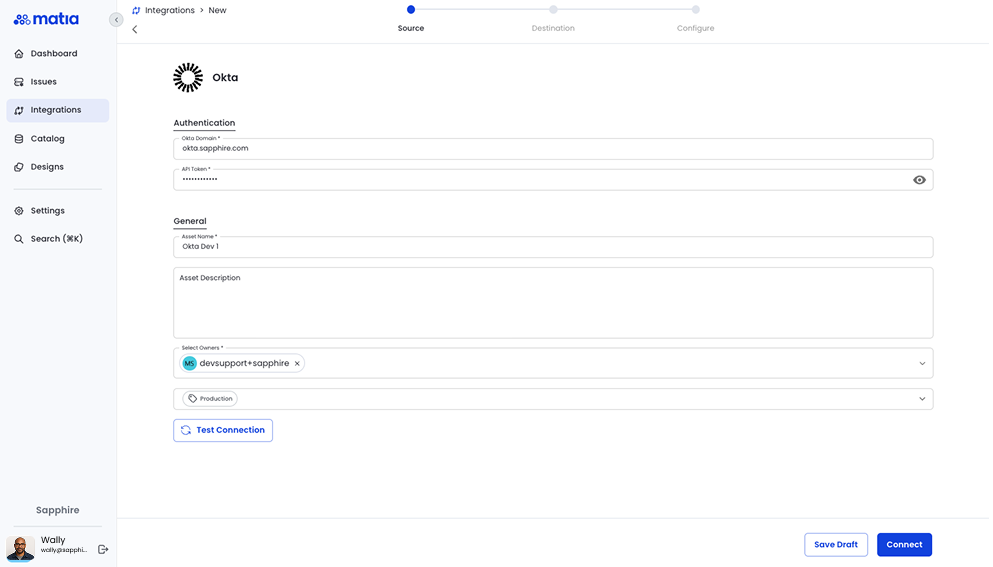
Step 6: Configure connector name, description, and owner
Step 7: Test connection and click Connect
The connector syncs core identity objects including users, groups, roles, devices, and system logs.
Mailchimp: Marketing Automation & Campaign Data
Email marketing often holds some of the most valuable engagement signals in a business, yet those insights usually stay siloed inside campaign tools. The Mailchimp Connector updates brings that data directly into your warehouse so teams can analyze audience behavior, campaign performance, and lifecycle engagement without relying on manual exports.
Matia integrates with Mailchimp’s API to pull core marketing objects including campaigns, sends, opens, clicks, subscriber activity, and list attributes. This creates a consistent, analytics-ready view of your email programs and how they influence downstream metrics like revenue, retention, and product usage.
The connector syncs campaigns, subscriber activity, automations, segments, tags, and reporting data.
Who It's For
Marketing teams, product managers, growth analysts, and customer success teams combining email engagement with product usage, revenue, and lifecycle metrics.
Apple App Store: iOS App Analytics & Performance
The Apple App Store Connector leverages App store connected API and brings your iOS app data directly into Matia so teams can analyze downloads, performance trends, user acquisition, and release outcomes without relying on manual exports or scattered dashboards. This unified feed lets you compare platform performance, track trends over time, and connect iOS engagement to product and revenue outcomes.
The connector syncs iOS app analytics, downloads, retention indicators, ratings, and release data.
Who It's For
Product managers, mobile app teams, and growth analysts tracking iOS performance alongside Android data, in-app behavior, and revenue trends.
Google Play: Android App Analytics & Performance
The Google Play Connector centralizes your Android app metrics in Matia, giving teams a complete view of downloads, ratings, performance trends, and release outcomes. Instead of relying on fragmented reports or ad hoc exports, you get a unified, analytics-ready data stream that helps you compare platform performance and understand how Android user behavior influences product and revenue outcomes.
The connector syncs Android downloads, ratings, performance data, and release trends.
Who It’s For
Mobile product teams and growth analysts evaluating Android performance across downloads, ratings, and release performance, and comparing metrics to iOS.
Email Connector: Direct Email Data Integration
Some data sources still rely on email to deliver reports or exports. The Email Attachment Connector gives teams a simple way to turn those incoming files into structured, warehouse-ready data without manual steps or custom scripts.
Each integration receives a dedicated Matia-managed email address. When a message arrives with an attachment, Matia automatically extracts the file, interprets its structure, and loads the processed data into your chosen table. Metadata like file name and timestamp is added for tracking and lineage.
The result is a lightweight, reliable path for any workflow that still depends on emailed files. It eliminates recurring file-handling tasks, keeps data current, and provides a consistent ingestion experience across partner reports, legacy systems, and internal exports.
Security is built in. Each address operates in isolation, all data is encrypted, and every action is logged for auditability. The connector feeds directly into your warehouse so your existing governance policies stay intact.
Who It's For
Sales teams, customer support operations, and data analysts who need to unify email activity with CRM data, support tickets, and customer journey analytics.
Xero: Accounting & Financial Data Streams
Financial data is at the center of critical business decisions, yet it’s often one of the hardest datasets to maintain cleanly and consistently. The Xero Connector gives teams a direct, reliable pipeline from Xero into their data warehouse, removing the friction of exports, custom scripts, or manually stitched-together reports.
Matia connects to Xero’s API and continuously syncs your accounting data into structured warehouse tables. This includes core financial objects like invoices, payments, bank transactions, contacts, and chart-of-accounts details. Instead of dealing with multiple endpoints or inconsistent CSV formats, teams get a unified, analytics-ready representation of their Xero environment.
Who It's For
Finance teams, CFOs, and business analysts consolidating accounting data with revenue metrics, customer lifetime value calculations, and operational dashboards.
The connector syncs accounting data like invoices, payments, bank transactions, journals, and contacts.
What's Next
Each connector uses Matia’s ingestion engine to automatically normalize schemas, track changes, and maintain sync integrity with built in observability so teams get data in their warehouse when they need it.
All six connectors are live and ready to use today. Additional streams will be added as needs arise. From enterprise identity management to mobile app analytics and financial reporting, we're making it easier to centralize the data that drives your business.






.svg)


