
.svg)


Introducing Matia MCP: The Fastest Path from a Data Question to an Answer


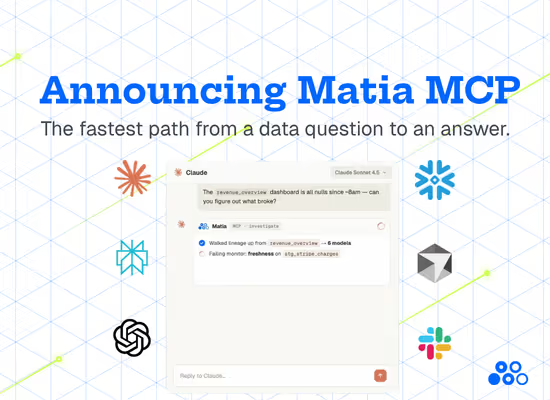
Today, kicking off Snowflake Summit, we're announcing that Matia MCP is in private preview.
If you've been following the data infrastructure space for the last year, you've watched a wave of MCP server announcements. Catalog vendors, observability platforms, warehouses, BI tools — most of the data stack now exposes an MCP server so AI agents can reach in and pull context.
That's a real shift. AI assistants that used to generate SQL and explain concepts can now actually act on your data stack. We think that's a good thing.
But we've also watched the limits of that approach become clear. And the reason we built Matia MCP the way we did has everything to do with what those limits are.
The problem with stitching context together
Most MCPs do something useful but narrow: they reconcile what your data tools expose through their APIs. The visible layer. The records, the metrics, the dashboards.
The challenge is that the failures that cost data teams the most don't always live at that visible layer. When a pipeline breaks mid-run, the API tells you it failed. It can't always tell you where it failed, what made it through, or what didn't. When a column changes silently between syncs, the dashboard tells you the number is off. It can't tell you why.
Agents can compensate for this by calling multiple MCPs in sequence. Pull metadata from the catalog, then alerts from observability, then query history from the warehouse, then dashboard dependencies from BI, then stitch it all together to form a working theory of what happened.
That works, in a limited way. But every added MCP burns more tokens, takes more time, and introduces more room for error. And the stitching itself is exactly the kind of multi-step reasoning current models are still unreliable at, especially under latency and context pressure.
This is the problem we set out to solve when we started Matia, well before MCP existed.
Why we built Matia unified from the start
Matia is a Unified DataOps Platform. From day one, we built it so that ETL, Reverse ETL, Catalog, and Observability live natively together in one platform.
That wasn't a marketing decision. It was an engineering one. When you build these four functions as separate tools and try to stitch them together later, what you get is a partial picture. Schema changes don't reach lineage. Monitor failures don't connect to integration health. Catalog ownership doesn't connect to BI consumers. The data team ends up doing the stitching by hand, in Slack threads and Looms and runbooks.
When all four are unified, something different becomes possible. Pipelines, lineage, monitors, modeled data, and BI consumers exist in one connected graph. Every asset knows its upstream sources, its downstream consumers, and its operational state. The graph is the platform.
That's the foundation Matia MCP exposes.
What this means for your agent
When your AI agent calls Matia MCP, it isn't pulling one slice of context and asking for more. It's getting a connected view across the stack in a single response.
A few examples of what that looks like in practice:
- A bad number on a dashboard. Matia traces upstream and surfaces the failing monitor or integration behind it, with investigation context inline.
- A failing integration. Ask the agent what broke. Matia returns the root cause and the full downstream impact — affected models, dashboards, and consumers — in one answer.
- A table deprecation. Ask which queries, dashboards, and people depend on a table before you drop it. Matia traces impact all the way through to the Tableau view.
In our testing, workflows that took an agent ten or more tool calls against single-vendor MCPs now take one or two against Matia. Fewer tokens. Sharper answers.
What's in the private preview
We're opening Matia MCP to a small group of customers and design partners first, so we can validate quality on real workflows before opening it more broadly.
The preview includes:
- A standalone MCP server compatible with Claude, Cursor, ChatGPT, and other MCP-enabled clients
- Slack as a supported surface
- Production safety primitives: request auditing, sensitive-data redaction, scoped permissions, and governed write access
A few of the use cases we're working through with early preview teams:
- Triaging a failed pipeline end-to-end, including identifying who to notify downstream
- Mapping deprecation impact from a table all the way to the Tableau view
- Diagnosing a bad number on a dashboard back to the failing monitor or integration
- Resetting false-positive monitor baselines with investigation context surfaced inline
- Cross-stack root cause analysis combining Matia MCP with Snowflake's MCP for workflows that span metadata and live data
We're also actively exploring how Matia MCP works alongside Snowflake's MCP for workflows that require both governed metadata and live query results. If you're at Snowflake Summit, we'll be demoing this live at booth 1603.
If your team is using AI tools daily and wants those tools to actually understand your data stack, we'd love to talk. Request early access to the private preview.
And if you're at Snowflake Summit this week, come find us at booth 1603. We'll be running the agent live on a real data stack and answering questions about how we built it.
This is a moment we've been working toward since we started Matia. We built a unified platform so that data teams could finally have one connected view of their stack. Now AI agents can have that same view. We can't wait to see what your team does with it.

.png)





.svg)


