
.svg)


How to Migrate From Fivetran: A Step-by-Step Guide for Data Engineers


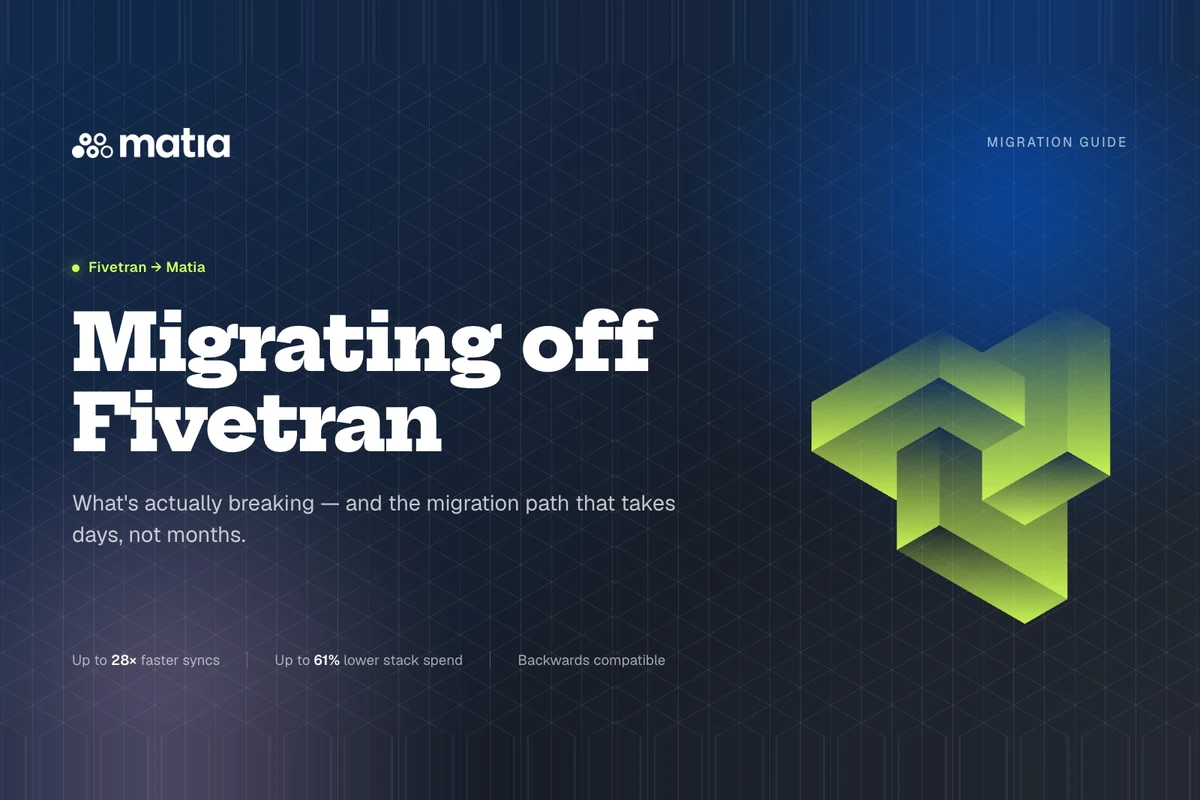
If you are running a modern data stack, chances are high that Fivetran is your primary ETL tool. For a long time, it was the default choice. You connected your sources, paid the bill, and got back to building.
That is no longer the case for a lot of teams.
Data engineers are increasingly hitting a wall with Fivetran. Pricing changes in 2025 and 2026 have made bills unpredictable. Pipelines that used to be reliable are becoming a source of constant firefighting. Teams are spending hours debugging broken connectors and explaining unexpected bill spikes to their CFOs instead of shipping.
If your Fivetran setup is costing too much or slowing you down, here is exactly what is going wrong and what a better migration path looks like.
Why Data Teams Are Leaving Fivetran
Fivetran is a large platform with hundreds of connectors, but its architecture was built for a different era. When you try to push it to support modern data needs at scale, the cracks start to show quickly.
1. Unpredictable Costs From Connector-Level Billing
Fivetran prices based on Monthly Active Rows (MAR). In 2025, Fivetran moved to per-connector billing, which eliminated account-wide volume discounts. Since January 2026, a minimum charge applies to every connector generating between 1 and 1 million MAR per month.
For teams running multiple connectors, this causes bills to spike in ways that are very difficult to predict or control. A single high-churn table can quietly generate millions of additional MAR per month, and you often do not find out until the invoice arrives. Teams with multiple low-volume connectors have reported cost increases of 40 to 70 percent or more after the pricing changes. Curious what this actually costs across different pricing models? Our guide to ETL pricing breaks it down.
2. The Black Box Problem
Fivetran abstracts away a lot of complexity, which is useful when you are getting started. But as your data needs mature, that abstraction becomes a ceiling. When something breaks, visibility is limited. You know a sync failed, but understanding exactly why, and fixing it fast, is harder than it should be.
Schema changes, CDC edge cases, and replication failures all require more control than Fivetran's managed model allows. Teams that need to customize ingestion logic, handle late-arriving data, or manage complex CDC patterns quickly run into walls. (If you're weighing CDC against traditional batch ETL, our guide to Change Data Capture covers when each approach makes sense.)
3. Slow Sync Speeds Without a Costly Upgrade
Fivetran's Standard tier caps you at 15-minute syncs. Getting down to 5-minute syncs requires upgrading to their Enterprise tier, which comes with a significant price jump. For teams that need near real-time operational analytics, a 15-minute batch delay simply does not cut it. And paying Enterprise rates just to get closer to real time, while still dealing with cost unpredictability, is a hard case to make internally.
4. The Tool Sprawl Tax
Fivetran handles ETL, but it is just one piece of the puzzle. You still need separate tools for Reverse ETL, Data Observability, and Data Cataloging. Managing four platforms with four invoices and four support queues leads to what data teams call data triage: spending all your time debugging across tools instead of building. Every new tool added to the stack is another contract negotiation, another onboarding, and another thing to break.
What a Better Setup Actually Looks Like
The problems above are not inevitable. They are the result of a specific architectural approach, and a different approach solves them.
Real-time CDC over batch. A platform that streams changes continuously, rather than pulling in batch intervals, eliminates the cost and latency problems at the root. MAR is consumed as it is written, so there is nothing to accumulate and no billing surprises.
Parallel syncs. High-volume tables do not have to be a bottleneck. Parallel sync architecture processes multiple streams simultaneously, dramatically cutting sync times without adding pressure to your source database.
Predictable pricing. Monthly Active Row billing should not be a surprise. A pricing model that does not penalize you for having multiple connectors or running transformations gives you the budget certainty that Fivetran's current model does not.
Built-in observability. Schema changes should not silently break downstream pipelines. Monitoring at the source, with alerts before bad data reaches the warehouse, is the difference between catching a problem in seconds and discovering it in a stakeholder meeting.
Fast support. Five-minute support response times are not a marketing claim. They are the difference between a minor incident and a major outage.
What the Migration Actually Looks Like With Matia
Matia was built by data engineers who were tired of exactly these problems. It is a unified DataOps platform that combines ETL, Reverse ETL, Observability, and Data Catalog in one place, built for speed and reliability from the ground up.
For Fivetran migrations specifically, Matia delivers:
- Parallel syncs that reduce replication time by up to 28x compared to batch-based tools
- Source-level observability that catches schema changes and anomalies before they hit the warehouse, with instant Slack alerts
- Pricing built on Monthly Active Rows, without the per-connector penalties or transformation charges that inflate Fivetran bills. Customers report up to a 61% reduction in total data stack spend.
- A dedicated Slack channel on every plan with 5-minute support response times
And if you are currently on Fivetran, the migration is not a months-long rebuild. Matia is fully backwards compatible with Fivetran. Pipelines and configs migrate in days, not months.
Ramp cut its sync time by more than 80% after making the switch. Recharge resolved chronic replication failures and unified a fragmented stack in the process. These are not edge cases. They are what happens when you stop forcing your data through a tool that was not designed for what you need today.
Stop Waiting on Your Next Fivetran Invoice
Migrating off Fivetran is not a moonshot project. Most teams put it off because they assume it means months of rebuilding pipelines from scratch. It does not.
With a platform that is fully backwards compatible with Fivetran, you can move your connectors, preserve your configs, and be running faster syncs at a lower cost before your next billing cycle. The longer you wait, the more you pay for a tool that was not built for where your data stack is going.
Book a demo today to see how fast you can make the switch.

.png)





.svg)


