
.svg)


Crunching Data Live: How Ramp Is Building the AI-Native Data Team


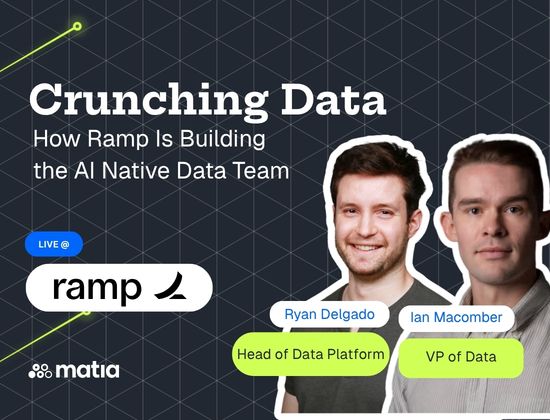
Most companies handing agents access to their data stack are solving the wrong problem. They're writing guardrails, tightening permissions, and adding approval steps. What they're not doing is making the correct path the easiest one to walk.
Every episode of Crunching Data before this one was recorded over Zoom. This one we did live in June 2026, on stage at Ramp's New York headquarters, in front of a room full of data people. Benjamin Segal hosted Ian Macomber, VP of Data at Ramp, and Ryan Delgado, who leads Ramp's data platform team. Ramp is a Matia customer and Matia is a Ramp customer, which made for a franker conversation than most.
If you're rolling out AI tooling to people who don't write SQL, this one is worth your time.
Here are some areas we dive into:
Ramp counts the days, and the number is 2,648 (at least at time of recording)
Ramp is a $44 billion company with more than 1,500 employees. It still runs on zero-to-one thinking, partly by design.
"We count the days that we've been in business at Ramp. And so today is 2,648. We start every single all hands meeting by talking about what day it is."
The other reason is structural. Ramp's growth isn't one curve, it's a stack of smaller ones: corporate cards, then bill pay, then procure-to-pay, then travel, treasury, accounts receivable, and now token spend management with an LLM gateway called Ramp Router. Every new bet resets somebody's clock to zero. As Ryan put it, it's a small startup inside a startup.
The economics team cost three billboards
Ian wanted to build an economics team. Ramp's co-founder and CTO thought it was a frivolous use of money. Ramp had recently run a billboard campaign that underperformed, so Ian knew exactly what a billboard cost, and what an economist would cost for a year.
"I can do more with an economist for a year than you can do with three billboards in 12 weeks."
He got the economist, then spent the next year quoting every budget request in billboard units. The hire was one person expected to write, do the economics, do the data science, build visualizations at newspaper quality, and shoot vertical video. Ramp's economics work now gets cited by the Financial Times. Ian calls the underlying principle investing from success: hire someone who can do the craft, watch what one motivated person produces alone, then scale whatever works.
Speed was the feature
In late 2023 Ryan's head of engineering handed him a problem. The product was slow, large enterprise customers were escalating, fix it. His team shipped in about six weeks, moving analytical queries onto ClickHouse as an OLAP layer.
The dashboard it was built for has since been retired, but the lesson held. What surprised Ryan was how much of the customer experience turned out to be latency. Making the application fast was the feature. ClickHouse now serves four to five hundred queries per second on Ramp's backend across roughly 20 canonical tables.
Buy vendors like you do talent; for slope, and empower your team to spend
Ryan's build-versus-buy rule is short. Build what your company is known for. Buy the rest, even the functions you need to do extremely well, because doing them well doesn't make Ramp Ramp. When he does buy, he evaluates vendors the way he evaluates candidates.
Not how good the product is today, but how much better it will be in two or three years. Is the founder customer obsessed? Is the team talent dense? You're investing in a team, not only a product.
Ian added the part you can act on tomorrow. Ramp lets junior employees who are passionate about a tool spend the money on it: under $15,000 just do it, around $30,000 do it and explain how you'll know it worked, more than that let's talk. Ramp got onto Hex because one enthusiastic person drove the rollout. The inverse is Ramp's churn signal, which is nobody internally being excited to take the vendor call anymore.
Seven out of ten data science fails quietly
Ramp's designers talk about seven out of ten design: build enough tooling that anyone can produce something decent, and let designers spend their time on what has to be a ten. Ian's team pulled that off for data science, then found the catch. Bad design fails loudly. Bad data science doesn't.
"It fails pretty silently, which is like a number that looks right but isn't."
He told a story about Ramp's chief product officer building what Ian charitably called a slop dashboard. When Ian pushed back, the answer stung: the only existing dashboard hadn't been shared in a standup, hadn't come up in Slack, and hadn't been updated in six months. Ian's read is that this is a data team problem. Attention is finite, and if your team doesn't build the assets everyone looks at, someone else defines reality for them.
Paved paths, not just guardrails
Project Glass started as one engineer's idea: put a coding agent inside a desktop application. Ryan admits he didn't see the point at first. What made it take off wasn't model access, it was the baked-in opinions and the paved paths into Ramp's internal systems. Glass connects to an internal app platform called Ramplify, carries a skills marketplace called Dojo, and ships Ramp Research, their data analyst agent, as a skill bundle. More than a thousand people at Ramp use it, most of them not engineers.
Which is exactly why the fundamentals got more important, not less.
"Well-modeled, curated, high-quality data is an absolute P0."
A data professional who gets a strange number will squint and ask whether the data looks right. Someone who isn't SQL-native won't. They'll read that revenue is two trillion dollars and take it at face value. So you give people reasonable defaults and automatic setup: the Ramp Research skill installs itself when someone connects the Snowflake connector inside Glass. Doing things for people before they ask is what makes it scale.
That's also how the semantic layer stopped being a data team concern. Ian's head of investor relations and CFO now know what one is and discuss it with customers.
Ryan's security corollary is worth repeating to anyone shipping agents this quarter. Agents inherit your permissions. If you hold the account admin role on Snowflake, so does your agent, and it will use it. Every access control that was merely good hygiene three years ago is load-bearing now. Mask the sensitive fields, give read access to production rather than the ability to mutate it, and then let it run.
Your next data hire may not be a data person
Ian's bet for the next few years is that data teams will hire more for business domain expertise than for data skill set. His example is a teammate who came through investment banking, private equity, a family fund, and a stint as chief of staff to a CFO.
"The limiting factor for her was never really like her technical ability."
She pushed some genuinely bad code her first month and better code her second. By the third month nobody remembered she hadn't always been on the data team, and the CFO now pings her directly. Four years ago Ramp hired heavily out of the dbt Slack community. Ian isn't looking there anymore. He wants someone who can push back on a CFO and change his thinking, because the stack is teachable.
How Ramp uses Matia
Ramp runs Matia for ETL from third-party sources and internal databases. Before the switch, historical resyncs took as long as 3.5 days and degraded over time. They now finish in about four hours, cutting sync time by more than 80%.
Read the full Ramp case study here.
For the record, asked for a bet the room would push back on, Ryan's first answer was that Matia will be a $10 trillion company. We're holding him to it.
Watch the full episode here.
Watch more Crunching Data
Here are some other episodes you might be interested in




.svg)


