
.svg)


One Catalog, However You Do BI: Matia Adds Hex


Matia's Catalog was never built around one BI tool. It was built around however your team actually does BI, whether that's Metabase dashboards, Tableau, or Omni's semantic layer, and it's already tracking lineage across all three. Hex is the newest addition to that pattern, and a place where SQL and Python sit side by side, and where the real analysis happens before anything gets polished into a dashboard.
That's exactly why it matters. The more real work a team does in Hex, the harder it gets for anyone outside the person who built the notebook to know how it works, or to prove it when someone asks.
Every team has that one Hex notebook that's basically tribal knowledge with better formatting.
Matia's Catalog now covers that too, so a number built in a Hex notebook gets the same on-demand answer to "where did this come from" as one built in any other BI tool.
The Challenge: Full visibility is missing
Most data teams can already answer "where did this table come from." Seeing what would break if you change a column, on demand, without waiting for the one person who remembers how a notebook was built, is harder.
That gap shows up in a few familiar ways:
- Catalogs stop at clean SQL. Most catalog tools either don't fully support Hex yet, or lose the thread the moment a notebook mixes in Python or a dataframe, even though that's often where the real analysis happens.
- Troubleshooting is slow and manual. Nobody wants a 3 AM Slack ping asking why yesterday's revenue number looks off, especially when the answer is buried in someone else's notebook. When a number looks wrong, someone has to work backward by hand: which cell feeds this chart, which column, which upstream source. That falls on whoever happens to be around, not necessarily the person who built the notebook.
- The problem compounds with scale. What's manageable at ten Hex notebooks gets a lot harder to track at a thousand, and leaders need a provable answer to "where did this come from," not a hope that the right person is around to explain it.
How Matia + Hex work together
Matia's Catalog automatically picks up what a Hex notebook produces: SQL query results and the columns behind them, and the visualizations built on top of that SQL. Lineage runs from the warehouse, through the dbt models Matia already tracks, through Hex's SQL cells, down to the column level, for both the query and the resulting chart and lineage for visualizations.
Python cells work a little differently. When a dataframe produced by Python code is referenced in a later cell, Matia identifies that reference and adds it to the catalog so the connection isn't lost.
That gives teams a real, provable answer instead of a guess:
- Upstream from a chart. For SQL-based visualizations, go from what's on screen back to the exact column it depends on
- Downstream from a source. From any warehouse table, see every Hex notebook that would be affected by a schema change or a data quality issue, whether that notebook is pure SQL or has Python in the mix.
And it plugs into the rest of Matia automatically:
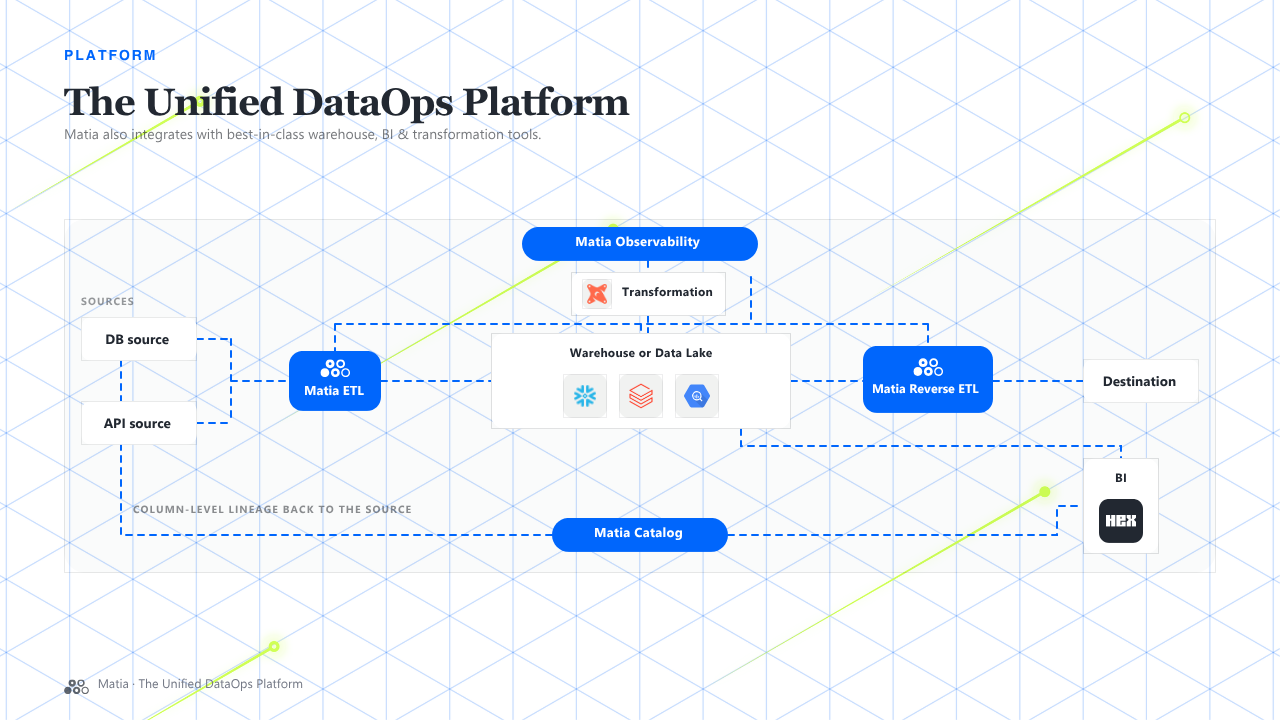
- Impact analysis, extended. When Matia's observability flags an anomaly upstream, freshness gaps, schema drift, volume anomalies, the same lineage graph shows which Hex notebooks sit downstream, so teams know what's affected before a stakeholder asks.
- One catalog, lower switching costs. Matia's catalog was never built around one BI tool, so it already covers Metabase, Tableau, and Omni, with Power BI on the way. That means moving to Hex, or running it alongside whatever you're migrating away from, doesn't mean starting your governance over. Tags, descriptions, and certification status already sync in from Snowflake and dbt, and now apply to Hex assets too, so nothing gets lost in the switch.
- No new maintenance burden. New tables, columns, and Python-touched assets get caught and linked automatically as Hex usage grows, no manual tagging required.
How data & business teams are using the Matia <> Hex integration
Nobody signed up to be a data detective, tracing Python cells backward through a graph at 5pm on a Friday.
Data engineers get a faster way to answer "what breaks if I change this" before shipping a schema change, instead of digging through notebooks or asking around.
Analytics engineers get to move at notebook speed without it costing them trust: no more manually retracing SQL and Python logic across three different tools to explain a number.
Head of Data get a provable answer to "where did this come from," on demand, at any scale, whether a team is running ten Hex notebooks or a thousand, without needing a separate catalog tool for whichever BI tool is in use.
Business stakeholders can take a Hex dashboard at face value instead of wondering what's behind it, because the lineage backing it up already exists and can be proven, not just claimed.
Same lineage, doing two different jobs: speed for the people building in Hex, confidence for the people relying on what they built.
Prove trust: benefits of Matia and Hex integration
Teams that already lean on Matia's lineage and observability to catch issues before the data reaches a dashboard. Asking the person who built it isn't a data strategy. Extending that same coverage into Hex means:
- Faster root-cause analysis when a number in a notebook looks wrong, because the lineage trail already exists instead of needing to be reconstructed by hand.
- Less duplicated catalog work, since Hex assets are tracked automatically instead of needing a separate tool or manual documentation to stay current.
- Fewer surprises from schema changes, because teams can see notebook-level impact before they ship the change, not after someone reports a broken chart.
- For teams also running Matia's ETL, the trace goes further still: lineage runs all the way back to the original source system, verified at every hop it moved through, not stitched together after the fact from whatever metadata the warehouse happens to still have.
Fast and explainable don't have to be a trade-off
Notebooks let analysts move fast. That speed is the point of Hex, but it's also exactly what makes some teams hesitant to fully trust notebook-style work the way they'd trust a traditional dashboard.
Matia's job here isn't to slow that down, it's to make sure fast and explainable don't have to be a trade-off.
And Hex isn't an isolated addition, it's the newest proof point in a pattern already underway: Matia's Catalog already spans Metabase, Tableau, and Omni, with Power BI on the way.
For Data, AI, and Engineering teams building in Hex, Matia is the Unified DataOps Platform that automatically catalogs and traces lineage across every Hex notebook, so any number can be explained back to its source, at any scale. Book a demo to see lineage into Hex in action.






.svg)


